Recruiting basics
Updated: Dec 3, 2025
A guide to understand the basics of the recruitment process of top universities.
Includes the pillars your applications must include and tips to decide when to apply.
The recruiting process at glance
To get into an MBA or Master´s program in a top university, you need to convince them that you are solid at six levels or pillars. These six pillars should be embedded throughout the application processes, specifically your resume, tests, essays, recommendation letters, referrals, and interviews.
SIX KEY PILLARS
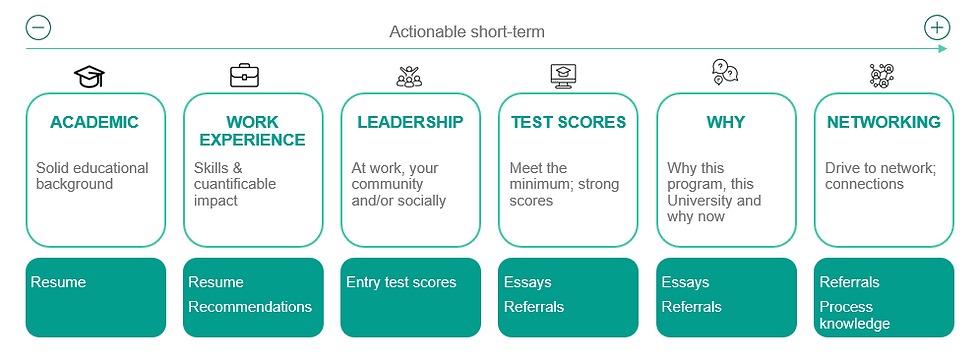
#1 Academic – You have a solid education background - shown in your resume
#2 Work experience – You have developed skills at work and made a significant impact - shown in your resume and recommendations
#3 Leadership – You led topics at work, in your community (e.g. volunteering), and in social environments (e.g. school alumni), and you can be specific about the details - shown in resume, essays, and recommendations
#4 Test scores – You achieved a high score in standardized tests - shown in test scores
#5 Answers to Why – You have convincing answers for:
Why this program?
Why this university?
Why now?
You also have clear mid-term goals and know how this University contributes to those goals - shown in essays and referrals
#6 Networking – you can network and expand your connections (regardless of how strong your network is today). By the end of the process, you will need to get referrals from alumni who attended the university you are applying to - shown in referrals. Read this blog about networking to understand why it matters.
There is a minimum to pass each of these six pillars. If you miss one, you will be either waitlisted or directly rejected. If you are rejected, you cannot usually apply to another round within the same year.
Pillars #1, #2, and #3 depend on what you did in the past. There is some room for action in the short-term; you can work hard on a resume that makes the best out of your experience; or you can sign up for volunteering if you are missing (community) leadership examples.
Pillar #4 depends on your ability to do well in this sort of exam, but it also depends on the time invested in preparation and your budget for retry attempts.
Pillars #5 and #6 totally depend on what you do today and can be significantly improved with networking and hard work from now on. Good news!
If you don´t meet the minimum for these five pillars this year, do not assume that next year the outcome will be the same. Universities value very much when a prospect candidate who didn´t make in the previous year tries again the following year. That is linked to Pillar #5 because you show determination to get into that specific university.
Before you jump into the advice for each application step, please keep in mind that general guidance and specific requirements vary from year to year. The best advice we can give you is that you become the “owner” of your own process by doing a lot of research and networking, especially with current students and recent alumni. No website alone will get you into a top university.
When to apply
Universities have several application rounds. You may read that there is no difference between applying to one or another. However, some people keep a (reasonable) theory in mind.
The most prepared, determined people are more likely to apply in the first round.
Why?
On the one hand, competition may be harder in the first round. On the other hand, if you are placed on a waitlist, you have more time for the university to change their verdict.
So, depending on whether your application is strong (or not), you may want to apply in the first round (or subsequent ones). Some people end up drafting a strategy where they apply to X and Y Universities in the first round and to Z and Q in the second. That makes sense since
(1) each application has a cost, and
(2) most universities tell you about their decision before opening the next round.
Another thing to keep in mind is that deferring one year your entrance if accepted is generally not possible. Universities select diverse profiles to design a specific mix of students in class. So, your profile may be a good match this year, but not the next one. Under very special circumstances one may be able to defer, but this is the exception and not the rule - and not a recommended strategy with top universities. Others are not so strict, so this may work.
Now that you know the basics, you can read here the next steps for applying.
< Click here to go back to "Postgraduate" Menu>


Comments