Applications: Step by step
Updated: Dec 8, 2025
Step-by-step guidance to make successful applications to top universities.
Includes sample answers and pro-tips for each application section.
To get into an MBA or Master´s program in a top university, you need to convince the recruitment team that you are solid at six pillars. These six pillars should be shown throughout the application processes (i.e. your resume, tests, essays, recommendation letters, referrals, and interviews).
SIX KEY PILLARS
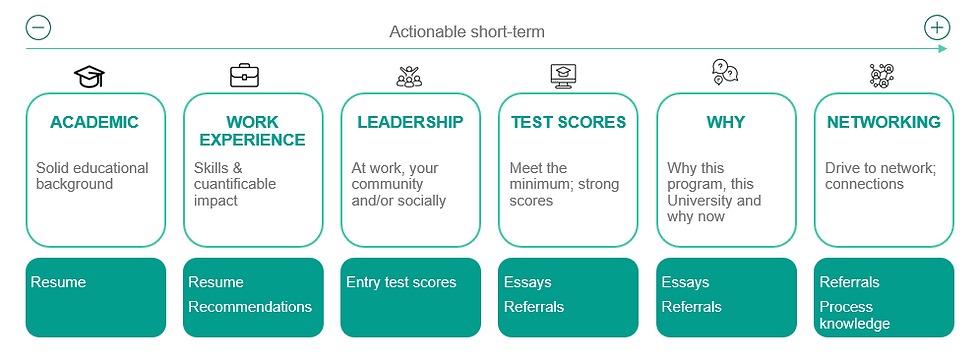
#1 Academic – You have a solid education background - shown in your resume
#2 Work experience – You have developed skills at work and made a significant impact - shown in your resume and recommendations
#3 Leadership – You led topics at work, in your community (e.g. volunteering), and in social environments (e.g. school alumni), and you can be specific about the details - shown in resume, essays, recommendations
#4 Test scores – You achieved a high score in standardized tests - shown in test scores
#5 Answers to Why – You have convincing answers for:
Why this program?
Why this university?
Why now?
You also have clear mid-term goals and know how this university contributes to those goals - shown in essays and referrals
#6 Networking – You can network and expand your connections (regardless of how strong your network is today). By the end of the process, you will need to get referrals from alumni who attended the university you are applying to - shown in referrals
In this post (recruitment basics) you can read a bit more detail on these six pillars
Before jumping into the advice for each application step, please keep in mind that specific requirements vary from year to year. The best advice we can give you is to become the “owner” of your own process by doing a lot of research and networking, especially with current students and recent alumni. No website alone will get you into an Ivy League.
Next, we provide with guidance on how to approach each stage of the application process.
Standardized tests
You will need to complete a graduate school entrance test: GMAT or GRE. GMAT is typically required for MBA and Business Schools, while the GRE is more generic because it is used for a broader range of graduate programs. Both tests measure your analytical skills, quantitative reasoning, and verbal reasoning. Here you can read more about the differences.
You may also need to complete an English test (unless you are a native speaker). TOEFL or IELTS IBT are the most widely accepted options. TOEFL is more structured and relies on multiple choice; IELTS IBT is more flexible, with sentence completion, map labeling, and short answer questions. Some universities are no longer requiring these language tests. Know which tests your target universities accept, so you choose the best option.
When to start preparing?
It depends on how much time you need to prepare. The recommendation is that you start as early as possible to ensure that you do not miss your target round because you haven´t got the needed score.
There are many platforms to prepare yourself, such as Target test prep or mba.com (GMAT) and Magoosh (GRE). Youtube also has useful videos (check out GMAT Ninja). Going over all the content of these platforms would take you nine months (full time), so do not try that. Instead, be efficient by doing this:
Learn about the structure and the timing constraints of the test and get acquainted with the questions
Practice some exercises of each section, so you know the basics
Take a few mock tests to know which your blind spots are
Based on that, focus on practicing the sections that need more work, so you can close the gap
Iterate and continue practicing until you get the score you want in the mock tests
Which scores do you need?
It depends on the universities, but it usually ranges between
GMAT: minimum 645 (= 690 in the old scale) / solid 665 (720)
TOEFL: +100; some like Harvard and Chicago require 103/ 106
Online form
Each university will require you to fill out some online forms: 9- 10 pages of personal info. We recommend that you:
Scan through the form to understand what sort of info they are asking for. This is useful to know what documentation you need to start gathering and what material you need to develop
Some sections ask for bullet points, paragraphs, or essays. Work on your answers in a Word file (so you can check the spelling and work on it easily)
Take time to review and draft the answers. You can save your progress as many times as needed
You will be asked to submit your recommender list, and they will receive emails with the questionnaires. If you feel comfortable, ask them if they can forward you the email, so you know what the questions are and can guide them on drafting the answers
If you are accepted, you will have to provide the original documents uploaded in the form. Ensure you review the details of each university to start gathering documentation if needed (e.g. transcripts in Spanish and English, transcripts from a year abroad as an exchange student, university certificates, etc. Some even require that the documents are officially certified by an international organization).
Resume
Here is some guidance for building a strong resume:
Review the instructions that each University has for the resume - e.g. some universities demand a much more detailed version than others
Focus your resume on achievements and impact, not just responsibilities and scope
Good: Defined a three-year multi-segment strategy for a regional bank to revamp the credit card business with projected incremental revenue of $X (+Y% over 2025 pipeline). In preparation for implementation.
Bad: Worked on a three-year multi-segment strategy for regional bank to revamp the credit card business.
Keep it concise (only one page)
Follow standardized sections: Education, Professional Experience, and Additional Information
Once you have a revised version, try contacting an alumnus to ask for help reviewing it (see the Network section at the end)
Adjust, revise, and adjust as many times as needed. As you network (especially with alumni), you will come up with new ideas. Getting to the final version may take months!
Below is a sample resume of a current MIT student in the US to give you a sense of how a strong resume looks like.

Essays (inc. cover letter)
Below are some sample essay questions. You are usually expected to write between 300 and 500 words.
Cover letter
How does your background shape the way you are today?
What is an important personal challenge that you had to overcome?
What are your career goals and how will studying an MBA at this university help you achieve these goals?
Here is some guidance for writing better essays. Generally, essays take quite a bit of time, and they are an important input in the decision process.
Design the structure (introduction- body- conclusion), the high-level ideas per paragraph, and key points before jumping into writing. This way, it is easier to ensure you are being strategic on the ideas
Review the specific format requirements of each university. They may be different
Keet in mind the KPIs of the recruitment team. Their performance is probably measured by the ratio of accepted offers / total offers to prospect students; and also by the percentage of students employed after three or four months (post-studies). So, they want "safe" candidates. This means two things:
(1) you need to be very convincing about the why (showing you will accept the offer if granted)
(2) they do not want you to make very risky decisions. So do not tell them you want to change industry, job type and country after your studies. Choose one change at most.
To know the whys, do research on the university history, the professors, the classes, the alumni, the culture, the life on campus, and anything else that is relevant to give more credible, specific answers to why. Do not forget the Student Clubs (such as Consulting, Fintech, Sailing, Beer, etc.) listed on the University website. It is important you know in advance which ones you want to join.
For the essay, address the letter to the Admissions Office and include the actual mail address. You can use a standard structure with:
(1) I am excited to …
(2) short paragraph, ideally catchy, summarizing what makes you a strong candidate
(3) specific sample(s) of how you recently applied the skills and the impact you had
(4) additional experience and examples from the past
(5) why an MBA and why this university
Have a catchy but not exaggerated introduction - it makes reading a nicer activity.
Avoid generic answers (“… and this had a great impact.”) or cliché responses (“… to become a better version of myself or grow as a person”)
For the leadership skill, show consistency in your involvement and also depth in your contribution (demonstrate that you actually care)
Include your thought process to decide/act the way you did to write more genuinely and show who you are
Have the writing proofread by a native speaker (or at least ChatGPT)
Adjust, revise, and adjust as many times as needed
You can use similar answers for different universities; just ensure what the Why this university is specific
Below is a sample cover letter of a current MIT student in the US to give you a sense of how a strong resume looks like.

Video-essays
Some universities may require you to do Video essays. They want to know how you react in a real interview. Some universities ask you to prepare in advance, and some ask for answers on the spot. A sample question would be “Present yourself to your classmates”.
Ensure you:
Research sample of questions/ answers on the internet to prepare well
Practice a lot in advance
Do not speak fast or in a flat/ boring tone
Look at the camera (eye contact)
Avoid unnecessary repetitions (e.g. "so...")
Recommendations
Below are some sample questions often asked to recommenders about you. Responses are often between 300 and 500 words.
How do you know the candidate? – provide context about your relationship
How do the candidate´s performance, potential, and personal qualities compare to those of his/her peers? – explain why the candidate´s skills, drive or impact at work is superior to most of their peers
What is the most significant contribution of the candidate to the organization? – e.g. include a specific sample about a project or an initiative the candidate led or was very involved in that had high impact (financial, operative, etc.)
Provide examples of why you think this candidate will succeed in the classroom – highlight key skills (such as problem-solving, team management and creative thinking) and examples of how these made a difference to peers / company
What is the most important feedback you have given to a candidate? How did the applicant respond? – include a specific situation where they took feedback and improved fast. Pick areas such as communication instead of a major issue such as lack of drive, proactivity, analytical thinking, or leadership)
Give an example of why you believe this candidate will succeed in their career - key skills (such as leadership and strategic thinking) and examples of how these made a difference to peers / company, and how they will help in the future
Being inclusive and encouraging others is important. Give an example when you witnessed the candidate living these values – a specific situation where they demonstrated these skills – either proactively (e.g. leading a cause at work) or was exposed to a situation where they demonstrated this
Most often, you will be asked for one or two recommendations. Here is some advice to help you prepare:
You can use the same names of recommenders and versions of recommendation letters for different universities. In most cases, questions are very similar. Nevertheless, make sure you read them carefully because there may be small variations across universities.
If possible, choose a recommender from your current job and a past job.
Choose direct supervisors who know you and have worked directly with you. You may be tempted to ask the most senior person in your company (CEO, Principal). Don´t do it. It is better that the recommendation comes from someone who knows your work well. Keep the senior ones for referrals since they are about general endorsement and do not need to know your work so closely.
Ensure that they provide specific examples when answering the questions (context, problem, action, and impact). Generic ones will not be enough to stand out from other applicants.
Consider the entire spectrum of key skills when considering the answers to choose the best fit. These could be analytical thinking/ data-driven, proactivity, problem-solving, stakeholders' management, team management, collaboration, resilience (such as work under pressure or achieving something under hard conditions), capacity to influence others (peers, clients, etc.), or capacity to inspire others.
Sometimes the recommender will ask you to write a draft, so they save time. That is fine, but ensure you discuss the content with them beforehand to guide them on what the letter needs to include.
If the recommender writes the letter themselves, book some time initially to share your thoughts about goals, why the university, etc. This way, they will have an easier time writing something that aligns with what you want.
Take responsibility for the content of the recommendation letters. Even if you do not write them directly, you need to know how to structure them, what to include, etc. Make sure you feel comfortable with the content before the recommender submits their statement.
Referrals
Most often, you will be asked for three or four referrals – one of them academic. Here is some advice to help you prepare:
Get one academic referral from a professor from your university (Bachelor´s)
For the rest, find alumni from the university you are targeting. Most universities do not read recommendations that do not come from alumni (re-read the networking section above for more detail on how to do this). If you do not know anyone in your network, you can read here how to do networking.
Ideally, find people (or draft the referral) in a way that supports different pillars (the six discussed above), especially those where your application is less strong.
The content should include at least:
(1) Their relationship with you
(2) Sample of skills/ impact (more generally than in the recommendation)
(3) Endorsement
If the recommender writes the letter themselves, book some time initially to share your thoughts about goals, why the university, and so on. This way, they will have an easier time writing something that aligns with what you want.
Take responsibility for the content of the recommendation letters. Even if you do not write them directly, you need to know how to structure them, what to include, etc. Make sure you feel comfortable with the content before the recommender submits their statement.
Sample XX
Interviews
After a couple of months of applying, you will be communicated whether you passed, you are on a waitlist, or you are out of the process.
If you passed, you will be invited to one or a few interviews (30-60 min).
In the first part, you will be asked questions like:
Tell me about you
Walk me through your resume
Why (program, university, now)
In the second part, you may be asked questions like:
How you define leadership
If I asked your boss, what would they say about you
Tell me about a situation where … (read about behavioral questions here)
Here is some advice to help you prepare:
Review and prepare as many questions as possible
Draft bullet points (high level) for your answers, so you can remember them easier on that day
Do not memorize your answers; they will not sound natural
Choose six or seven stories that are very relevant and know them by heart. You can use these as your safe options. Ideally, these stories reflect several skills, and depending on the question, you can adjust them on the spot. For example, think of a project where you managed a team, worked under pressure and supported a team member who was struggling. The story is a good fit to show leadership, resilience, and teamwork – you just need to twist the focus accordingly
For situational/ behavioral questions, use the STAR method – Situation, Task, Action and Result (read more here)
Avoid taking time to prepare, so you answer on the spot. If you get stuck with a question, politely ask for a few seconds, breathe deep and think through your answer
Be ready to be challenged – they will ask you many whys (why that bachelor’s, why that job change, etc.). Have answers ready
Have questions ready for the recruiter. Do not ask very basic questions and try to leverage your knowledge for the first part of the questions
Sample questions may include: “I am very interested in joining X and Y Club. Is there any other that you would recommend, or that you consider a hidden gem?”, or “Ten people told me very similar things about the culture on campus: A, B. Anything else that you think is important?”
Some universities, like Columbia, are well known for having relatively easy interviews; others, like Wharton or MIT, are tougher. Just be prepared for the hardest, so that day you don´t struggle.
In this post we help you polish your resume to begin with the university recruitment process.
< Click here to go back to "Postgraduate" Menu>


Comments